Rapid Production Marketing
412.996.5700
  • Home
  • About
  • Articles
  • What we do
  • Launch Your Product
    • Zip Code
  • Speaking
  • Fees
  • Clients
    • Innova Questions
    • What They Say
    • Auto & Truck
    • Manufacturing
    • Motorsports
    • Supply Chain
    • Organizations
  • Contact
    • Blog

10 Twitter Mistakes Made By Marketers In The Manufacturing Industry

11/15/2010

3 Comments

 
Written by: Norman Wright
 “
Wright-To-Know”
This article reposted by permission. 
Many manufacturing companies that are finally jumping into social media have no strategy.  A good number seemingly are checking off a list of social media tools they have subscribed to show their participation. What is more telling is their lack of credibility and comprehension of how to use social media to generate new business for themselves.
Twitter is one of the social media tools that can be used as a tool for your manufacturing company’s social media marketing strategy to generate online traffic and a pipeline for new business leads. It is the leading traffic generator to my Wright-To-Know blog.
​
Here are ten mistakes marketers in the manufacturing industry should  avoid if they want to generate new business through Twitter:
  1. Signing up then not participate. A tell-tale sign that Twitter is nothing more than a check-off on your social media check-list. When you rarely post to Twitter it will show.
  2. Self Promotional Tweets. Marketers that sound more like cars salesmen, constantly using promotional Tweets to tout their company’s new hires, new business acquisitions, awards, etc.
  3. Hiding behind the Company’s veil. Using your company’s  name as the Twitter account without revealing who is doing the Tweeting. Even Ford Motor Company gets this right, having allowing @ScottMonty to be their social media spokesperson under his own Twitter name rather than through the company’s name. It’s awkward to try and engage with a company. Social media is about people. A lot of the same principals of face-to-face networking applies to social media networks such as Twitter.
  4. Auto Responses. These drive not only me but will drive your prospects crazy. They are impersonal, and usually contain no value other than to clog up your Direct Message box forcing you to scan through dozens and dozens to reach those who have sent you a personal one.
  5. Little if any value to your Tweets. 80 to 90% of my tweets are resources for my audience to help them with their new business challenges. They are a combination of posts from my blog and other resources that I usually find and pass on in my morning ritual of reading my RSS feeds in Google Reader. I use a tool called bit.ly to post an article, along with a shortened URL to Twitter.
  6. Fail to generate Twitter traffic ‘to anything”. I have recommended to manufacturers that they should have a blog that becomes the “gateway” to company and generate traffic to the blog through tools such as Twitter. The blog serves as the central component to your social media strategy.
  7. Failing to use 3rd party Twitter tools. These tools can help you identify your best target audience and build your Twitter account’s data base of followers within the ratios mandated by Twitter. Your company’s blog content can stay fresh with new postings but older posts have a very long shelf life from not only SEO but also through repurposing posts to Twitter using some third party Twitter Tools. At our firm we have a process in which we syndicate our clients content over and over again… very much like a traditional media schedule. It’s naive  to think if you have written a post and everyone has read it.
  8. Using the reply function when you should use a direct message. Not every reply needs to be share with your entire Twitter audience. Almost all replies should probably be sent by Direct Message to the person.
  9. Failing to engage in the conversation. It amazes me that most marketers in the manufacturing industry have reservations about engaging with their prospective client audience.  Social media and tools such as Twitter, provide the most efficient means of creating personal network with your agencies best prospects. I have thousands of followers on Twitter alone and it is easy to stay engaged and be part of the conversations without it requiring an undue amount of time. I probably spend no more than 15 minutes a day responding through Twitter.
  10. Allowing the early adopters of Twitter to mandate how your company should use it. Face it, Twitter has superseded anything envisioned by its creators or early adopters “way back in 2006.”  It’s amazing that it was the celebrities, not ad agencies, that first figured out the value and potential of Twitter.
3 Comments

Social Media for Industrial Marketing, Part 2: YouTube

11/10/2010

1 Comment

 
In this installment of “What’s all this about Social Media and where do I start?” we’re going to explore YouTube in some detail.  In this posting you’ll find out the following:
  • Why – Why should you post it
  • How – How you can create your own YouTube Channel
But first, the basics….
In the beginning we’re going to review some  information, then you can watch some video’s.  Again, it’s best to open a new screen to use the video and pause it as you begin to create your channel later on. 

Creating Your YouTube Channel

Since this is a basic tutorial about YouTube it just makes sense to use YouTube Video’s to explain it...
I realize that this isn’t the greatest video you have ever seen.  BUT, this is the only video I have found that takes you through the set up step by step setup.
You might also want to check this video out:

Subscribers, Subscribing & Friends

Ok, now let’s remember that YouTube IS a social media outlet.  Probably THE most powerful outlet that you have at hand to get your message out in a clear and succinct fashion.
​
Remember when we talked about Search Engine Optimization in a previous posting?  Creating a YouTube channel and not subscribing to other video channels or not making another  a “favorite” is not following those simple words of wisdom on the sugar packets: Advertising: Shout it from the mountaintops.
Search engine optimization (SEO) is the process of improving the volume or quality of traffic to a web site or aweb page (such as a blog) from search engines via “natural” or un-paid (“organic” or “algorithmic”) search resultsas opposed to other forms of search engine marketing (SEM) which may deal with paid inclusion. The theory is that the earlier (or higher) a site appears in the search results list, the more visitors it will receive from the search engine. SEO may target different kinds of search, including image search, local search, video search and industry-specific vertical search engines. This gives a web site web presence.
Ok, Now the plain English: The more sites your site is connected to, the more chances you have of being higher in the rankings. Don’t get me wrong, there is a lot more to it. But the basics remain the same. The more sites your site is connected to, the more chances you have of being higher in the rankings.

Now, Here’s the next important thing: What happens when you go to an industry event or reception?  The first thing you do is look around for people you know.  This is a very very common human trait.  You want to be comfortable.  You want to find who else you know that is there.  Pretty simple eh?
Social Media is THE SAME WAY! Just like we talked about on the LinkedIn posting:
  • SHOW YOUR CONNECTIONS!
  • SHOW YOUR FRIENDS!

​This is all under MODULES. In order for people to participate they want to know who you know, and who they might be introduced to.  THAT is the very essence of networking and social media is ALL ABOUT NETWORKING.
1 Comment

Social Media for Industrial Marketing, Part 1: LinkedIn

11/3/2010

0 Comments

 
As a follow up to my previous posting “What’s all this about Social Media and where do I start?” Several people have written and asked for some more details.  I realize that I presented an awful lot of connections and links and it left some folks completely new to the subject dazed and confused.

I’m realizing that many of the folks connected to me only have a few connections, incomplete profiles and probably aren’t getting much out of LinkedIn. In this posting I’m going to explain what social media outlets we chose  as an industrial distributor. I’ll break this down into the social media categories, and then walk you through some of the basic steps of getting started.  I also try to give you a time estimate of how long it will take you to get the “basics” in place.
​
Out of all the social media sites available we chose FOUR outlets. Hopefully after you are done with all three parts of this posting you’ll feel less like the blind men discovering the elephant.
  • LinkedIn
  • Twitter
  • YouTube
  • Facebook

LinkedIn (Total Time: 15-45 minutes, depending on your profile)

Start by clicking the link below.  Hit the back button when you’re done viewing.  It’s probably a good idea to open another window to edit your LinkedIn account while you go through the slides. I’m going to go into more detail below about slides 29 & 30 so don’t worry if you don’t get it at first.

LinkedIN Basics
View more presentations from Concept Hub, Inc.Getting started with LinkedIn is very simple, and, since you’re probably reading this from my LinkedIn profile connection you probably have at least the start of your profile complete.  Regardless, take a look at this slideshow and make sure that you haven’t missed anything.

As I’ve mentioned before, I’ve been on LinkedIn since my neighbor told me about when she was a beta tester (Thanks Cindy!) It’s been interesting watching it evolve and content features been added.  However, that’s also a problem.  New features get added that are great and you don’t always know about them until you see the changes in your other contacts.  Which is a another good reason to look at your connections 😉
​
Ok, watch the slide show in the link above, Complete the basic steps and then we’ll move on. If you haven’t watched it yet.
——————-> LinkedIN Basics

Setting up Your Company Profile. Here's Why it's Important

Slide 29 & 30 are the ones that you should take a close look at. 

​If you haven’t set up your Company Profile DO IT!
​

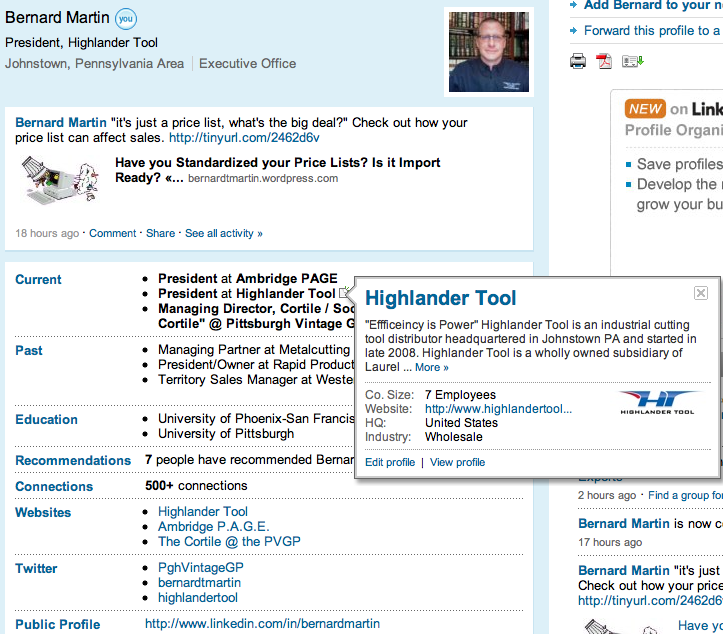
Once it’s complete you’ll have a great mouse-over feature so people can find out more about your company.

​I’m constantly surprised how many business owners in my connections have never take the quick 5 minutes to create this free advertising spot.


Bernard Martin LinkedIn Profile 2010
LinkedIn Profile Company Mouseover

Why is my Company Profile so important? GROUPS!
Having your company profile in place is important for Groups.  But before we dive into groups, look again to the right and notice the”Connections” area of the upper profile.  You already know that you can click on the Connections to see who you might know in your friends connections.  This is afterall a social network.
​
If you where to scroll all the way to the very very bottom of my profile you would find the following statement.  The items in bold are the important part.
“I prefer to only be contacted by people I know, have met personally, or have had business, professional contact. or dialogue with in some forum. I welcome new connections from members of groups that I am actively involved in but I prefer not to connect until we have communicated. I am not an open networker and I do not wish to submit my connections to “business trolling”. I hope you understand and appreciate my position on this issue.
As it was explained to me when I first learned about LinkedIn: “It’s like a networking group based upon the “Six Degrees of Separation”

Wikipedia says: “The LinkedIn professional networking site operates on the concept of how many steps you are away from a person you wish to communicate with. The site encourages you to pass messages to people in your network via the people in your 1st-degree connections list, who in turn pass it to their 1st-degree connections.”

LinkedIn has blossomed into a very useful business tool with Groups and Answers sections, but the basic premise of the site is whom do you know that I know, how can I help you network and conversely how can you help me network.

That said, I am wary of people whom I link to who have their connections locked down. IMHO, it flies in the face of the very basic concept of LI as a networking tool. If you invite me to connect, and your connections are closed, I will send you an email in this regard.
​

You may have your reasons for locking your connections and I certainly respect that. I feel that I am connecting with people whom I respect and who I may contact one day with opportunities for their professional advancement or, conversely, whom I might contact with a question. For that reason I will only maintain connections with those people who make their connections available to their 1st level” contacts."

Groups (Total Time to find &  join: 5 minutes)

David Erickson has a great blog post entitled “LinkedIn Best Practices for Business“.  It’s worthwhile to check out if you have a few minutes to read more.  But, if you don’t here’s what he says about Groups:
“Join industry groups. Search for and join industry-related LinkedIn groups , even if there is no activity within them. The icons for those groups will show up on your profile which tells people at a glance that you are involved in your industry and presumably knowledgeable about it. It also creates a connection between you an anyone else who is a member of that group. If the group is active, join in the conversation where appropriate. This is an opportunity to demonstrate your  expertise.”

I’ve recently had a discussion with several fellow members of the ISA – Industrial Supply Association about the groups function.  

Several fellow members are connected to me but are not in any of the groups.  There’s a conference next weekend and there’s some wonderful dialogue taking place within the group.  Connections are being made.  

I’ve been in the situation before. I’ll run into two people who I know at an event.  One of them will pick up a conversation that we’ve been having online.  Finally, a question is raised by the other person, who we are both friends with “When did you guys talk about all this?”  We explain that it’s all online via a  GROUP.  “Hey, maybe you should join it, You’re a member aren’t you?”
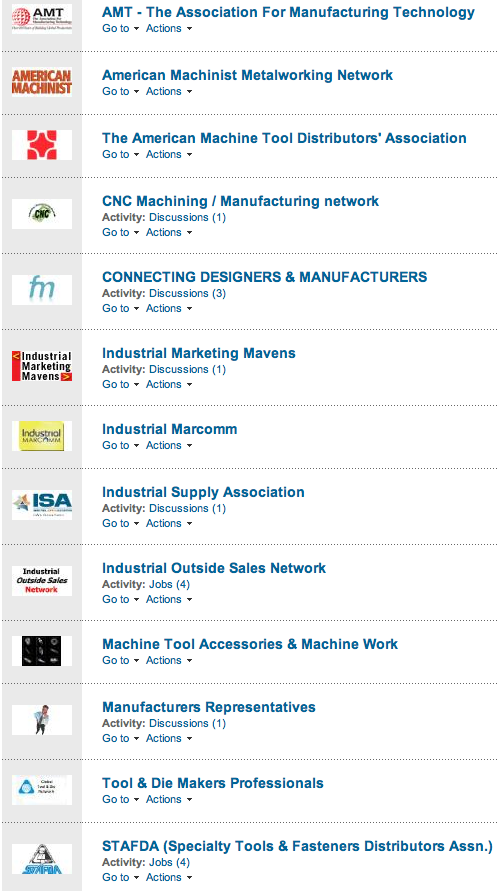
LinkedIn Industrial Channel Groups
Industrial Channel Groups
If you’re a member of any of the groups that I’m a member of you can either click on my profile or you can search for other groups under the group drop down or the search area to the right of the header on your LinkedIn page.

Starting your own Group

Once you’ve mastered some of these basics you soon start to realize that maybe you yourself should start a group.  If you’re a manufacturer, you could start one only for your distributors, if you’re a machine tool builder, one just for your dealers, a distributor, one for your customers. Agents can start groups for their distributors… there are really endless ways you can use the group functions to create the “conversations” so often talked about in social media.

If you start a group. Your Invitation Filtering should look like what you see above.  Otherwise, your members aren’t going to be able to connect with you. There’s some great ideas on creating and managing your own LinkedIn Group at Mashable “8 Tips for Managing a LinkedIn Group”  The list is below and the details are at the link. It’s worth delving into if you want some more information.
  1. Use a Personal Touch
  2. Lay Some Ground Rules
  3. Praise the Good, Deal with the Bad
  4. Help Your Members Promote Themselves
  5. Add Some News Feeds
  6. Facilitate Connections Outside of LinkedIn
  7. Take a Poll
  8. Promote Your Group

One final note on Groups.  If you start a group be prepared to support it and get responses.  If you watched the Facebook F8 video above you’ll hear about a problem called the “rule of 5”  If someone comes into your group and they don’t see 5 people they know they’ll probably not participate.  So if you’ve got a email list of the members you want to invite, send them all an invite to LinkedIn, followed by an invitation to join the group.

Social media is about connecting and building relationships – talking to people. Taking part in discussions gets you noticed as well as keeps the conversation going and the sharing of information, viewpoints and knowledge

So, for goodness sake, if you start a group and ask questions and topics start rolling for goodness sake answer and respond!
​
I hope that you found this informative.  Please feel free to add any comments.  I know I’ve barely scratched the surface of Linkedin so if you have some observations or insights please feel free to leave a comment (and yes, I’m working on unlocking it so your comments post immediately but I’m still learning about all the WordPress functions so bear with me)
Thanks for reading 🙂

0 Comments

Why Video Works in Industrial Marketing : Neuro-Linguistic Programming

10/13/2010

4 Comments

 
EDITORS NOTE: There have been many questions related to the legitimacy of Neuro-Linguistic Programming. For a more complete ongoing discussion please check out the responses on Quora: Is NLP (neuro-linguistic programming) scientifically proven? If yes then how? And if no then why are some people getting powerful results and some psychologists giving it the green signal?

Why is television such a great medium compared to radio? It has to do with something called Neuro-Linguistic Programming.
Picture
According to Neuro-Linguistic Programming Model people learn in different ways. This is often called the VAK Model (visual / auditory / kinesthetic). According to this model the general population learns according to the following percentages:
  • Visual – 75%
  • Auditory – 6%
  • Kinesthetic – 19%
It would then follow that since 81% of people learn via visual and auditory ques, as the theory goes, video is the best method of communicating a message.


Why YouTube is Awesome!
Until the advent of YouTube, where you are creating your own video channels, there was no way to utilize this in marketing for the manufacturing sector.
​
This social media platform is probably the BEST one that we have found for communicating with our customers about new products AND for our salesforce to learn more about the product. Here’s why:
  1. Statistically, knowledge retention from a sales meeting is about 20% at the termination of the meeting. Without “refreshment” and “review” this tracks down to a 5% after 14 days. (That’s why it’s important to have simple bullet point sell sheets, but that’s a topic for another time)
  2. The more the salespeople show the video, the more they learn about the product. Kind of like my old college friend who saw Monty Python’s the Holy Grail so many times that now, 20+ years later, he can still recite the lines verbatim.
  3. At the distributor level, creating a YouTube channel and “favoriting” your vendor’s video’s allows the salesperson to cross-sell other products because of the “wow, what’s this?” factor
  4. SEO! Again, you are cross-linking by “subscribing” or “friending” others. Hence you are creating broad cross-links which raises YOUR profile in searching.

Do’s and Don’ts for YouTube:
  • DO look at several other channels within our industry before creating your own channel if you have not created one before. Yes, my 11 year old created his own channel for his stop motion videos he makes but you want to observe what others are doing, what you like, and what you don’t like.
  • DO add every video of every product that you still make and stock. Even if the video is 12 years old, load it. Our industry is disconnected enough that someone may be seeing it for the first time.
  • DO add different versions of the same video. You may have an old video and you’ve since redone it with some other language but you deleted some sections that you know longer felt where important.
  • DO add a link and and Icon to your company website.
  • DO create “tags” for your videos. Remember the meta-tagging section up top?
  • DON’T let your marketing person make it part of his or her own personal youtube page: it shouldn’t contain a picture of the family dog in the profile.
  • DON’T assume that “we already have that video embedded in our own website so we shouldn’t load it on YouTube”. YouTube let’s you enlarge to a full screen, provides embed code (so people can add it to their blogs, etc) and it’s ON the NETWORK.
4 Comments

Click Fu: How to Double Your Conversion

9/29/2010

3 Comments

 
Take a few minutes and watch the video about building websites. Where does your eye look when it goes to a website?
3 Comments

How Do You Get Customers to Land Where You Want Them To?

9/15/2010

1 Comment

 
Where do your customers LAND somewhere when they search the Internet?
​
The Common Actions Desired of Your Company Landing Page:
  • Get a visitor to click (to go to another page, on your site or someone else’s.
  • Get a visitor to buy.
  • Get a visitor to give permission for you to follow up by email or phone.
  • Get a visitor to register for a newsletter or updates.
  • Get a visitor to tell a friend.
  • Get a visitor to learn something, which could even include posting a comment or giving you some sort of feedback.

Ok, Now let’s take a look at your options to drive traffic to your website:
Social Media User Data 2009
Do you have any idea how MANY social media sites there are?!??! Take a Look at this link on a List of Social Media Sites. 

Which ones are best for your company?  

​Before you get overwhelmed let’s dig a bit into the Big names:
  • Facebook
  • Twitter
  • LinkedIn
  • YouTube


Facebook
It started in 2004 and was originally limited to Harvard students.  In 2006 anyone over the age of 13 could join. In 2007 Facebook created an area called Pages that enabled companies to create profiles for themselves. And in 2009 they introduced a LIKE button for users to click on and let people and companies know what they liked.
Top Insights from January 5th, 2009
  • The 35-54 year old demo is growing fastest, with a 276.4% growth rate in over the approximate 6 months since we last produced this report
  • The 55+ demo is not far behind with a 194.3% growth rate
  • The 25-34 year population on Facebook is doubling every 6 months
  • For those interested in advertising alcohol on Facebook, there are 27,912,480 users 21+, representing 66.3% of all users.
  • Miami is the fastest growing metropolitan area (88.5%) and Atlanta (6.4%) is the slowest
  • There are more females (55.7%) than males (42.2%) on Facebook – 2.2% are of unknown gender.
  • The largest demographic concentration remains the college crowd of 18-24 year olds (40.8%) which is down from (53.8%) six months ago.
Take away? Parents and professionals are rapidly adopting Facebook. Companies should be paying attention to this but it may not yet be ready for prime time.
A sidebar note worth thinking about:
The real interesting thing happening with FACEBOOK is the bleed of the Gen Z and Gen Y demographic. As the older folks have embraced FB the younger folks have begun moving to more specialized sites that meet there unique individual needs and interests. This is typically a footnote in most of the analysis.

“Facebook has just gotten too big & too commercial, I won’t “friend” a company and let them see all my info, but I’ll still Fan a page, You just gotta watch” I recently heard a 20-something say to me.

Remember when I said earlier that the whole concept of social media is evolving? It is.

Ok, so you’re probably wondering what the difference is between a PAGE, a Group, and a Community on FB. You may want to check out Marketing Your Business on Facebook: Group or Page?

We have elected NOT to use Facebook for industrial clients yet as the demographic we are targeting, At this time, industrial buyers are not using FB for research. That could change.

Twitter
Twitter is a free social networking (micro-blogging) service that allows users to send and read messages known as “Tweets”

“Tweets” are text based posts of up to 140 characters displayed on the author’s profile page and delivered to the authors subscribers “Followers”

We are we using Twitter for industrial marketing.

Why?

​Remember the search engine optimization stuff?
Picture

LinkedIn
LinkedIn is fast becoming THE business tool of social networking. Rather than summarize why just click this link to find the 33 Ways to Use LinkedIn for Business

At a minimum create a company profile page for your company.

You can take a look at the company profile we created for
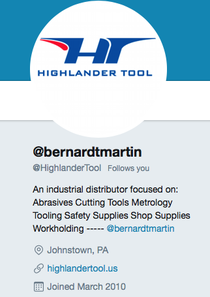
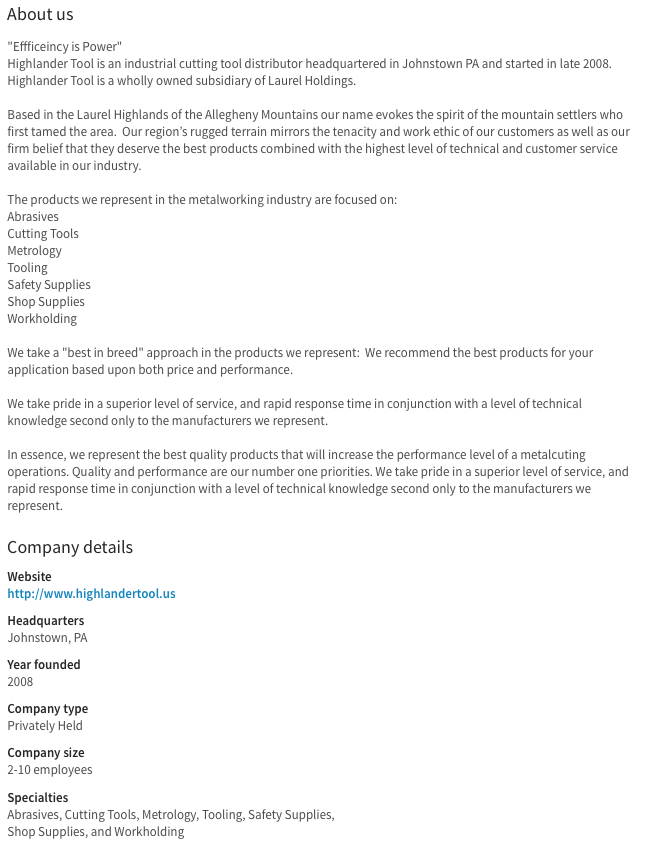
Highlander Tool Company here. It’s pretty simple to create. One thing you will notice is that we have taken our brand message very seriously. The message we set up is to communicate what we do and who we are. …and we’ve used essentially the same message for every social media profile. (So once you create ONE you can cut and paste, albiet with some editing, for all of your Social Media sites.
Highlander Tool LinkedIn Profile
YouTube
Creating a YouTube channel was really driven out of necessity.

Below is an excerpt of an email I sent to everyone in our company when we launched our YouTube channel:

“I wanted to make you aware that this weekend I worked on finally getting a central place where you can show customer’s product videos from their computer while visiting their facility."

This presents some pretty big cross-selling opportunities!

So, How Do You Get Customers to Land Where You Want Them To?
Each one of the above social media website always you to let people who follow you about new products and to direct them back to the exact landing page you want.
1 Comment

Industrial Marketing: Why Brand introductions FAIL

8/18/2010

1 Comment

 
IMTS Talk Interview on Bringing Your Product to Market
There are some common denominators in why some new product launches fail, while other, inferior products, are successful in industrial sales chanels marketing programs.  This article breaks out some o nth more common causes of the failures.
 “Faulty execution of a winning combination has lost many a game on the very brink of victory. In such cases a player sees the winning idea, plays the winning sacrifice and then inverts the order of his fellow-up moves or misses the really clinching point of his combination.”
​~ Fred Reinfeld , The Complete Chess Course

​Below you will find six key points to think about. Think of these six as cylinders in a car. If five of them are working but not all six you've lost all forward momentum.
​
Marketing Materials
Are catalogs, price lists, flyers, trade show schedules, advertising schedules, lead processing all provided in a timely fashion? Does the vendor send in 25 catalogs for a sales meeting with a salesforce of 5 people and a customer base of 250? What is the package quantity of literature? Does the literature have a part number? Is there a literature request form? Who is that sent to? Are the marketing materials “intuitive”? (are all of the components needed to complete and order listed in the catalog? Is the catalog easy to use and find all related products? What about videos? Social media sites? Brand exposure?
Quality of Product
Does the product have “walk away reliability” or does it suffer from a myriad of quality issues. This goes beyond the product working as it was marketed to work and includes horseshoe nail problems (no torx screws in the box, partial shipment of all components. Is the distributor going to spend all the money that would have been made on the margin servicing the customer and trying NOT to get "egg on their face" in the process which will affect other product lines and the relationship with the customer?

Competitive Pricing
Does the product provide a good ratio of price to performance? Is the vendor adaptable and responsive to price corrections in a short time frame? Has the vendor provided all of the necessary sales information to “sell” the value added? 

Availability
Is there stock? If so on what products? Many times distributors have heard on new product introductions that “there is plenty of inventory” only to find out that “Well, we have three pieces of everything”. If there is a stock out problem, is the vendor proactively responsive contacting the distributor on late deliveries before the distributor calls to expedite? ​

Customer Support
Are the field support and customer support team trained and up-to-speed on all of the products? Can they technically support the product line? Can they crossover competitive information? Do the support people say “I don’t know the answer to that” and end the conversation with “Are your happy with my your level of service today?” or do they say “I don’t know the answer let me find out and call you back in 10 minutes”. Are they responsive? Are they proactive? What is the SOP on quote turnaround ( 2 hours, 24 hours, 2 weeks)? Customer service can take on many variations. I've listed a few for you to ponder.  

You can read more at: Customer Support: How it Can Cost You Sales

Perhaps, more than any other item on the list, this TRUST IS THE MOST IMPORTANT. 
​
Trust
Is there trust in the relationship? This is the "gut feeling" stuff. It comes out in the one-on-one conversations. Is something being held back? Are direct answers given? Is the manufacturer asking lots of questions as if he where going to handle the business directly or take it through a competing distributor? Is the manufacturer "throwing his weight around" and not really acknowledging that the distributor runs their own business? Does the agent or manufacturer call the end-user directly....and not tell the distributor or independent rep? Do they visit the end-user on their own? 

The most successful brands are built on a foundation of trust and loyalty. Each party knows where the other stands. You can actually watch the relationships grow. In the early phases it may be that the distributor or the agent calls up the manufacturer and asks for something... The reprimanding parent response is "You know we can't do that! We can do xxxx." To which the smiling reply is "I know, but I had to ask." Later, as the relationship evolves, when the distributor or agent calls up they say "Hey, we just promised this program and that promo with this product, I know I need you to approve it but I already quoted it while you where on vacation" and the response "Great Job, what else ya need?" 

Read more at: Trust: The Most IMPORTANT Factor in the Supply Chain
Brands are sold ONE person, ONE customer at a time until they tell two friends and so on, and so on, and so on, until it's viral.
As a final thought, I'm reminded of a picture from the 1970's that hung in the VP of Student Life's office back when I was Student Senate President. It showed a picture of a HUGE Sit-In protest over some student issues. The caption read: "Communication is the beginning of Understanding" Good words to live by in your channels branding efforts
1 Comment

How the Industrial Buying Cycle has Changed

6/16/2010

1 Comment

 
The four stages of the industrial buying cycle have remained constant over time. What’s changed, however, is how buyers go through the four stages.

Today, online methods dominate the four stages of the buy cycle.
Picture
Buyers conduct
  • Research on the Internet
  • Contact suppliers
  • Request quotes online
  • Compare supplier offerings using content found online
  • Submit purchase orders online
Buyers use
  • Search engines,
  • Online catalogs,
  • Supplier Web sites,
  • Portal sites
Today, buyers gather data, review product specifications, view drawings and more—all online. They bookmark Web pages, download content, and print out information to share with other decision makers.

​Even traditional sales through offline channels such as purchase orders often are the result of buyers using online methods to move through the stages of the buy cycle.


How to Get Found Early in the Buy Cycle
In order to make the final short list of potential vendors, suppliers must get found in the early Needs Awareness and Research stages of the buy cycle.

A GlobalSpec survey found that 42% of buyers evaluate four or more suppliers during the Research stage, but only 26% of buyers get quotes from four or more suppliers during the later Procurement stage.

The conclusion is that as buyers move through the buy cycle, they eliminate suppliers from contention, as opposed to adding new potential suppliers to their short list.

That’s why it’s so important to be found early
  • 70% of buyers review four or more pieces of content for purchases greater than $10,000
  • 17% of buyers review that much content for purchases under $1,000.
“Suppliers must create a robust library of content and make it available online to buyers. The content should be targeted to multiple different decision makers, such as the economic buyer seeking ROI and value vs. the end user seeking features and functionality. 

Your content should include specification sheets, white papers, Webinars, e-newsletters, application notes and more. Only with this breadth and depth of content can you help build confidence in the buyer that your brand and solutions can meet their needs, and at the same time, distinguish your company from your competitors.”
​

~ GlobalSpec newsletter, March 23, 2010
1 Comment

What Are the 4 C's of Social Media?

5/19/2010

43 Comments

 
4 c's Social Media Community Content Conversation Conversion
Ok, so the previous posts have given  you have some information, but which one of the social media outlets should you choose?
Just hang on a minute. You should know about the 4 C’s of Social Media:
  1. Communities
  2. Content
  3. Conversations
  4. Conversion
1. Communities
Traditional advertising is about interrupting.
Social media is about sharing and interacting.
  • 78% of social media users interact with companies or brands via new media sites and tools, an increase of 32% from 2008.
  • 95% of new media users also believe companies or brands should have a social media presence.
  • 89% believe that they should interact with their consumers using social media.
2. Content
  • No hard selling
  • DO NOT communicate a sales message
  • DO IMPLY a sales message
  • Consumers want entertained, informed, and educated.
  • If they like your content they will probably like you.
If you share good content consistently over time they will likely begin to trust you
3. Conversations
Traditional Advertising: Talking AT someone.
Social Media: Talking WITH someone.

What are “Conversations?”
  • A comment on a blog post,
  • A retweet
  • A comment on your LinkedIn or Facebook
  • A “Thumbs Up” on a Facebook wall
Yes, it’s going to take some time. Interesting that I recently had a conversation about Twitter. it was compared to snack food: “It tastes good, takes alot of time to eat, but has no nutritional value” At this point in time in the manufacturing sector, that is probably a true statement. In 6 months….?

THE KEY: You put out a message or content and someone chooses to respond.
These conversations and those among others will have an impact.
  • 51% of respondents say that social media has influenced their online transactions.
  • 78% of consumers trust peer recommendations
4. Conversion
All of the pieces should work together to lead to Conversion.

Common mistake: Send people to the home page. It builds traffic but may not help build DIALOGUE.
​
Remember when we talked about Search Engine Optimization (SEO) a while back?  
Did you click on that link?
You probably should. It’s pretty important.

In fact, if you haven’t read it here’s the synopsis:
The time was when the search engines looked for key words to rank you via a formula. Now part of that formula is whom you are LINKED to from your website. The more links you have to someone who also has alot of links is a good thing and will drive searches to you.

I recall a conversation back in 2003 with a principal of mine, when I was an agent, and he said that HIS company name and website appeared 2nd on a google search while my website appeared above it. I explained then that it had to do with understanding the links and how the formula works.
43 Comments

“Why Not  Facebook?” For Industrial Marketing

4/23/2010

0 Comments

 
The first question you are probably asking is “Why not  Facebook?”  for industrial marketing.  The simple reply is "Perhaps not just yet."

Until 48 hours ago when FB held their annual F8 Conference in San Francisco, FB was great for hooking up with friends and keeping your personal life separate from your business life.  

Many people want to keep it that way.

We decided that Facebook is a great medium for a company that markets to the public but the industrial sector is
  1. Not using it for business.
  2. Has it blocked in their firewalls.
  3. It’s just not the place for us.

​Your decision may be different.  

​However, there are a few things that Mark Zuckerberg announced that are worth being aware of, but we’re going to watch this evolve before we embrace it.  

However, if you get the chance, do click on the link and watch the video announcement.  That will help you when I talk about the “social graph”. If you don’t have the time to check it out here’s the synopsis:

Your Facebook page today, tomorrow the world.
Mark Zuckerberg announced aggressive plans at the f8 conference on Thursday to integrate Facebook into every aspect of the Web. Plans include opening up Facebook’s Social Graph and allow embedding social experiences.

Until recently, sites can store information about Facebook users for 24 hours. Zuckerberg said that opening up the Social Graph removes the time restriction, allowing sites to customize their features for FB users.

The Facebook “like” feature will also be released as a plug in. Users who come across a website can click on the “like” button and share the information with their Facebook friends instantly.
​

Zuckerberg said at the conference that he expects to serve 1 billion “like” buttons within the first 24 hours after the plug-ins launch.
0 Comments
<<Previous
Forward>>

    Author

    Bernard Martin

    Archives

    August 2026
    October 2025
    March 2025
    January 2018
    October 2017
    August 2017
    January 2017
    October 2016
    September 2013
    July 2013
    August 2012
    June 2012
    January 2012
    April 2011
    March 2011
    February 2011
    January 2011
    December 2010
    November 2010
    October 2010
    September 2010
    August 2010
    June 2010
    May 2010
    April 2010
    March 2010
    December 2009

    Categories

    All
    AMTDA
    Branding
    Business Analysis
    Database
    Eastec
    Facebook
    GEO - Generative Engine Optimization
    IMTS
    Industrial Distribution
    Industrial Marketing
    LinkedIn
    Logo Development
    Machinery Dealer
    Machine Shop
    MSA
    NLP
    OODA Loop
    PDCA
    Price Lists
    SEO
    Small Business Marketing
    SME
    Social Media Management
    Social Media Marketing
    Southtec
    Speaking
    Strategic Planning
    Twitter
    UNSPSC
    USMTO
    Westec
    YouTube
    Zip Code

    RSS Feed

©2025 Rapid Production Marketing        232 Dogwood Circle Baden, PA 15005-2346      412.996.5700